
Anisotropy and Strain Energy in Decahedral Particles
Abstract
This study analyzes the strain energy stored in decahedral particles through finite-
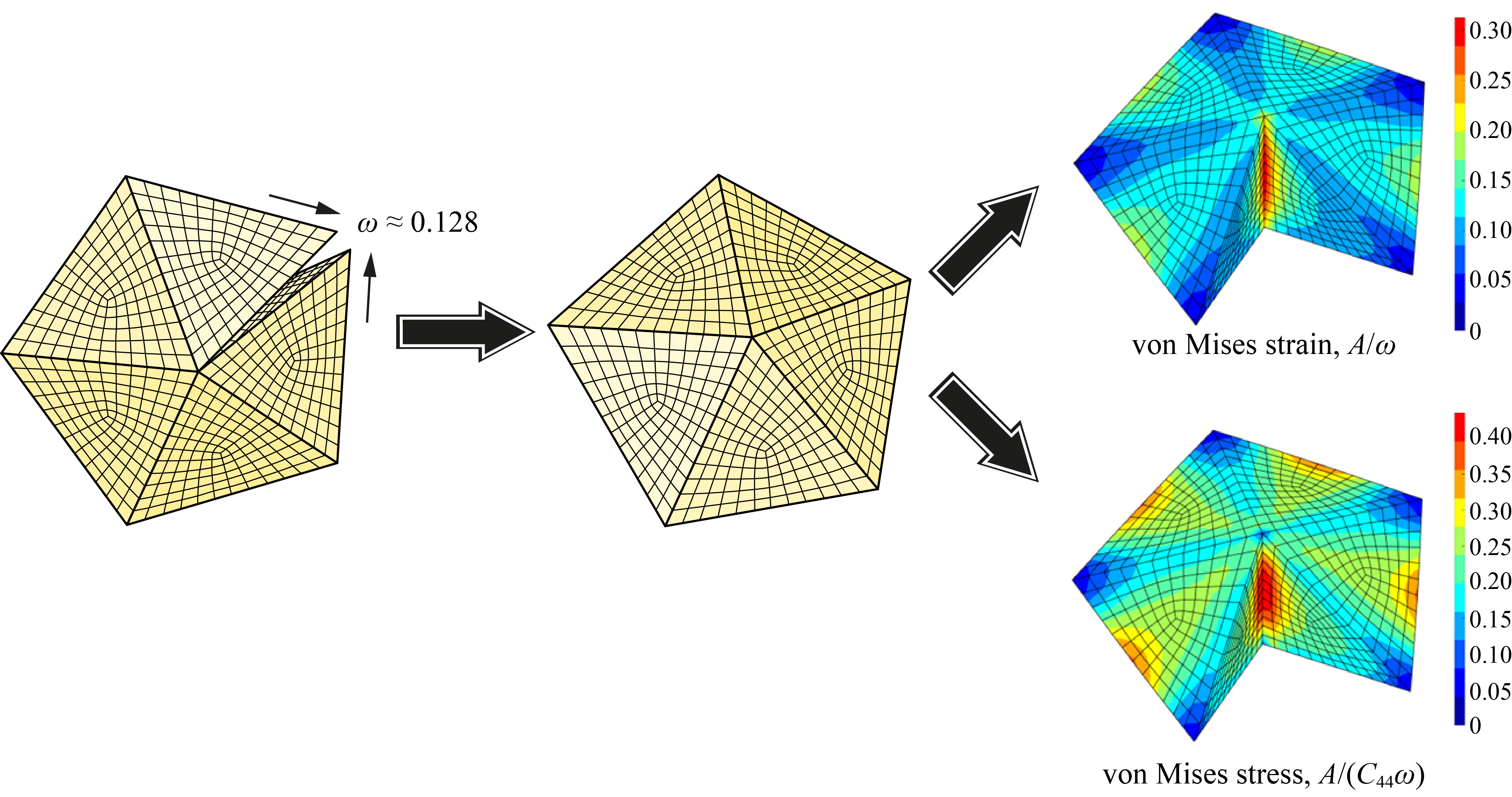
element (FE) simulations that fully account for material anisotropy. The particle is modeled as an assembly of five perfect tetrahedra with a geometrically necessary gap. A two-stage FE procedure is employed: first, prescribed displacements close the gap to generate the eigenstrain; second, the resulting stress-strain state is calculated as the elastic response arising from the introduced eigenstrain. To quantify the influence of anisotropy on the particle strain energy, we introduce an anisotropy coefficient, defined in terms of the engineering elastic constants. The numerical results are compared with isotropic analytical models based on Voigt, Reuss, and Hill homogenization schemes for a range of face-centered cubic metals. We demonstrate that isotropic approximations consistently overestimate the strain energy, the Reuss scheme provides the closest agreement to the FE solution (deviations below 26% even for highly anisotropic Pb). For weakly anisotropic materials such as Al, the considered schemes yield similar inaccuracy of approximately 8%. Our findings underscore the necessity of incorporating material anisotropy for accurate quantitative predictions of strain energy in decahedral particles.
Keywords
Finite-element method; Strain energy; Disclinations; Decahedral particlesFundings
Russian Science Foundation: 23-72-10014


This is an open access article under the terms
of the CC BY-NC 4.0 license.
Metadata is available under the terms of the CC BY 4.0 license